
Our Latest Publication
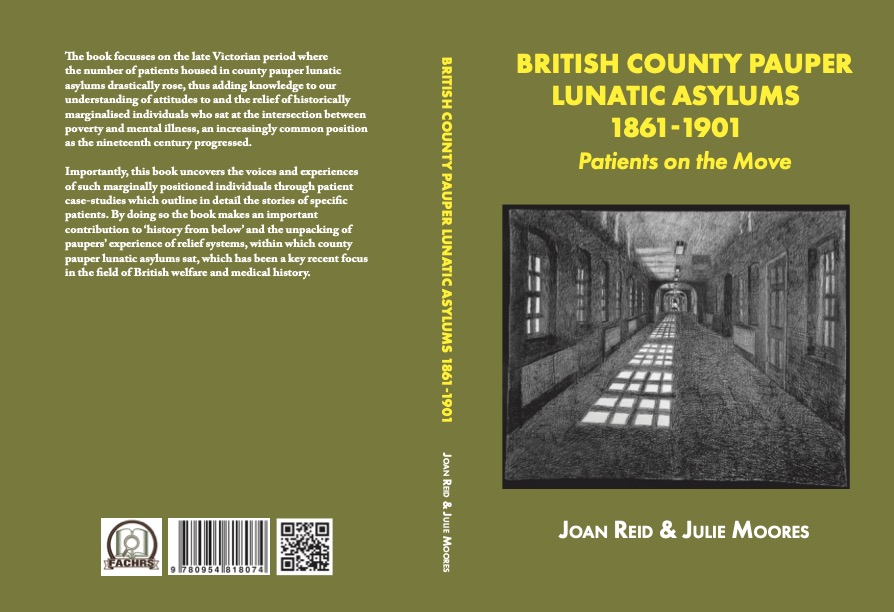
British County Pauper Lunatic Asylums 1861-1901
What will I learn from this book and what will I find between the covers?
The book focusses on the late Victorian period where the number of patients housed in county pauper lunatic asylums drastically rose, thus adding knowledge to our understanding of attitudes to and the relief of historically marginalised individuals who sat at the intersection between poverty and mental illness, an increasingly common position as the nineteenth century progressed. Importantly, this book uncovers the voices and experiences of such marginally positioned individuals through patient case-studies which outline in detail the stories of specific patients. By doing so the book makes an important contribution to ‘history from below’ and the unpacking of paupers’ experience of relief systems, within which county pauper lunatic asylums sat, which has been a key recent focus in the field of British welfare and medical history.
To purchase the book, please visit the shop.
Journeys into Genealogy Podcast
Brita Wood, Our esteemed Membership Secretary, recently took part in the Journeys into Genealogy podcast where she was interviewed by the host Emma Cox. Brita talks about FACHRS and the historical research projects done by our members on topics including station masters, lunatic asylums, almshouses, allotments and more. There is a small extract below:
To listen to the podcast please click here.
Out and About with the Roadshow
Each year Brita Wood and other members of FACHRS travel all over the UK taking what we call the “Roadshow” to live Family History Fairs and Shows. At each venue FACHRS has a table(s) to exhibit information about our Society, showcase our newsletters and Family & Community History Journals. There are copies of FACHRS publications for sale; these are books that have been produced from the research undertaken by our members while taking part in both major and annual projects (more information on those on the relevant pages). We also have a selection of what we call “previously loved” books available. Most important of all Brita or Lois and their team are available to answer questions about FACHRS and what we are all about and how you can benefit from joining the Society. We hope you will be interested and join the society and maybe make a few purchases.
The pandemic saw physical fairs and shows cancelled and replaced with virtual shows. These continue especially in the winter and FACHRS will have a virtual stall/booth where possible. We have a video explaining what FACHRS is about at some of these and a display of our products. Like the physical events you have an opportunity to chat to Brita or another FACHRS volunteer who are there to answer any questions you may have, and if you are interested you can then join the Society.
Have a look on our Events page to see where we will be in 2026. Why not attend a physical show or fair and enjoy the experience of walking round the stalls and meeting us ‘face to face’. If you can’t travel, why not visit a virtual show by going to their website where you can see who is exhibiting at the show, what talks are available to watch, buy a ticket (some are free or are usually cheaper if you buy in advance) and then log in to the show on the day. Keep coming back to see more dates as shows are announced. We look forward to seeing you at one of them.
Full details about all the shows we are attending in 2026 are on the Events page.
About the Society
| Founded at a meeting of over 100 people at the Open University (OU) in Milton Keynes on 18 April 1998, FACHRS (it rhymes with “thatchers” or “crackers” – your pick!) was first suggested by Shirley Fisher a former student of OU Course DA301 Studying Family and Community History: 19th and 20th Centuries. “The aims of the Society are to promote and communicate research in family and community history, with a particular emphasis on the contribution of locally based micro-studies, especially through collaborative research. Over the years, major projects have resulted in books on the Swing Riots, 19th century Allotments, and Almshouses and a number of mini-projects that have proved immensely popular, with 30-40 per cent of Society members taking part.” Professor Michael Drake If this sounds exciting then please consider becoming a member. We come from a variety of backgrounds and you will always find a cheery welcome. |